Home/Blogs/Reactive Dog Training Tips: From Basics to Advanced
Reactive Dog Training Tips: From Basics to Advanced
Does your dog bark, lunge, or growl at other dogs, people, or moving objects? That reaction might feel frustrating, but it does not mean your dog is aggressive or untrainable. Reactive dogs simply respond to triggers with more intensity than the situation calls for. With the right approach, you can help your dog feel calmer, safer, and more confident.
This guide walks you through reactive dog training strategies — from the very basics to more advanced techniques — so you can build a stronger bond with your dog and enjoy walks without stress.
What Is a Reactive Dog?
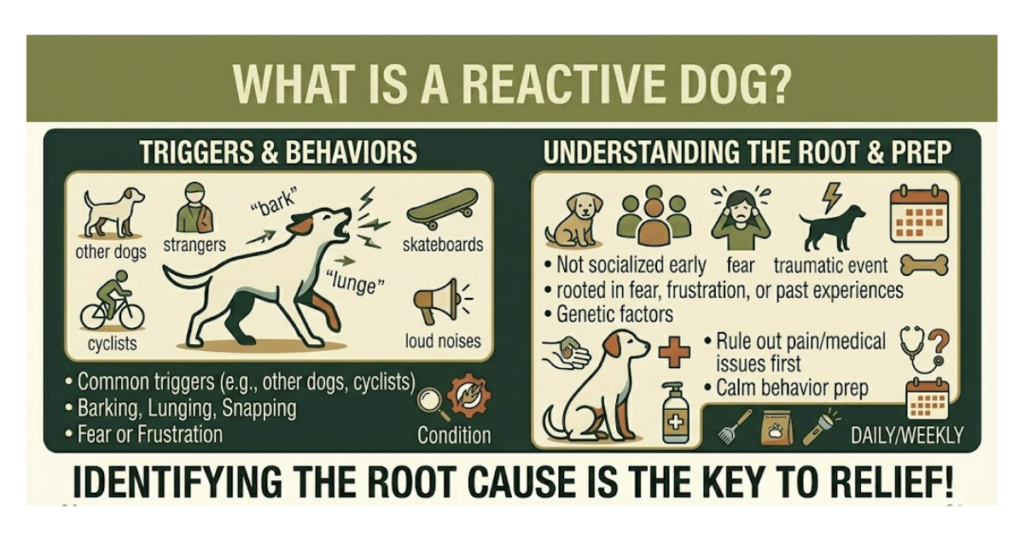
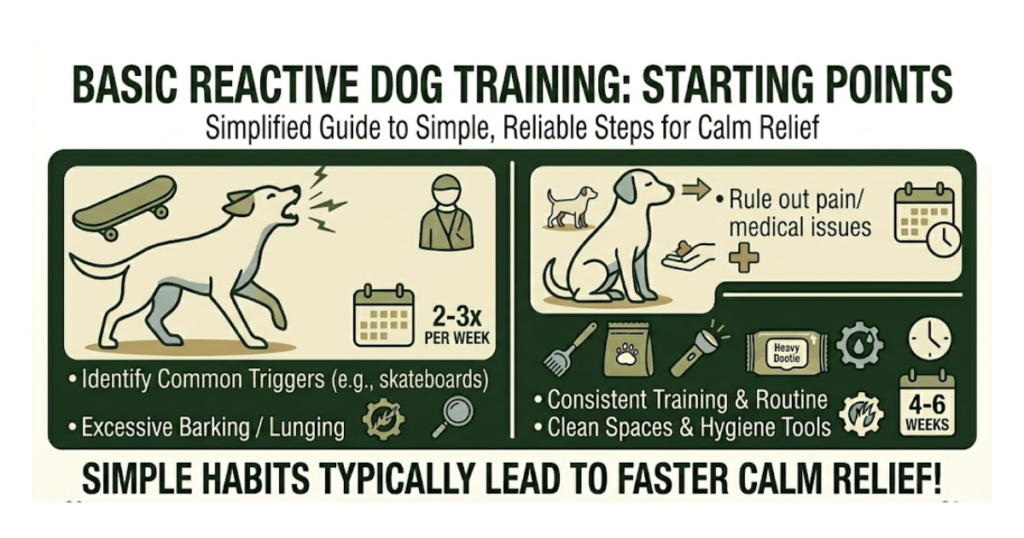
A reactive dog overreacts to specific triggers in its environment. These triggers vary from dog to dog, but common ones include other dogs, strangers, cyclists, skateboards, or loud noises. Rather than ignoring these things, a reactive dog goes into overdrive — barking, lunging, snapping, or spinning in place.
Reactivity is often rooted in fear, frustration, or past experiences. In many cases, dogs that were not well socialized during their early months develop reactive tendencies later. That said, reactivity can also stem from genetics or a single traumatic event.
Before starting any training plan, it helps to rule out pain or medical issues. A dog in discomfort may react more intensely than a healthy one. Once your vet gives the all-clear, you can confidently begin working on behavior.
Understanding Thresholds and Trigger Stacking
One of the most useful concepts in reactive dog training is the idea of a “threshold.” Your dog has a tipping point — the distance from a trigger at which it can still think clearly. When your dog is below that threshold, it is calm enough to learn. When it goes over, it reacts.
Trigger stacking is what happens when your dog encounters multiple stressors in a short time. For example, a car backfiring in the morning may not cause a reaction on its own. However, if your dog also saw another dog on the walk and heard a child screaming, those stressors pile up. By the afternoon, even a small trigger can push your dog over the edge.
As a result, managing your dog’s environment is just as important as active training. Keeping your dog under threshold consistently gives the brain a chance to reset and learn.
Basic Reactive Dog Training: Starting Points
1. Build a Strong Foundation with Basic Obedience
Before tackling reactivity directly, make sure your dog has a solid grip on basic cues like sit, stay, leave it, and look at me. These commands give you reliable tools to redirect attention during a trigger event.
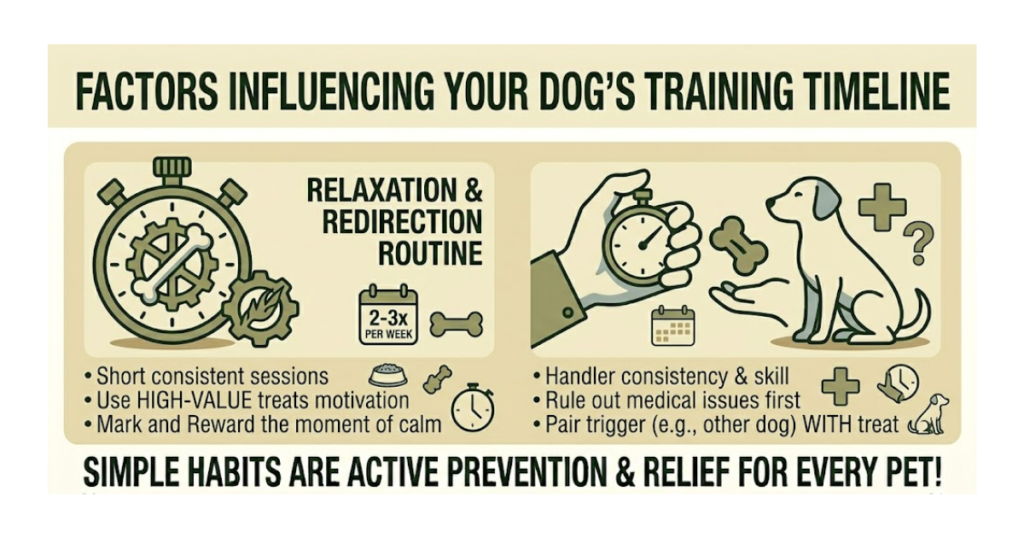
Short, consistent training sessions work best — aim for 5 to 10 minutes a day. Use high-value treats that your dog does not get at any other time. This keeps motivation high and helps your dog associate training with good things.
2. Use Desensitization and Counter-Conditioning
Desensitization means gradually exposing your dog to its trigger at a low level, then slowly increasing the intensity over time. Counter-conditioning means pairing that trigger with something positive, like treats or play.
For instance, if your dog reacts to other dogs, start by standing far enough away that your dog notices the other dog but stays calm. The moment your dog looks at the trigger, offer a high-value treat. Over many repetitions, your dog begins to associate the sight of another dog with something good.
This process takes time and consistency. Progress is often slow, and that is completely normal. The key is to stay below the reaction threshold throughout.
3. Practice the “Look at That” Game
This technique, popularized by trainer Leslie McDevitt, teaches your dog to observe its triggers without reacting. You mark and reward the moment your dog glances at the trigger and looks back at you.
Over time, your dog learns that noticing triggers earns rewards — and that checking back in with you is a great strategy. This shifts the emotional response from panic to curiosity.
Intermediate Techniques for Reactive Dogs
Focus Work and Attention Training
Once your dog understands the basics, you can increase the level of difficulty. Start practicing in slightly more challenging environments — a quiet parking lot, a park at off-peak hours, or a neighborhood street with some foot traffic.
Teach your dog to hold eye contact with you for progressively longer durations, even with mild distractions in the background. This builds impulse control and strengthens your communication as a team.
Emergency U-Turn
This is a practical skill that prevents over-threshold reactions before they happen. Teach your dog to spin and walk in the opposite direction when you give a specific cue or signal.
Practice the U-turn without any triggers first, rewarding generously each time your dog follows through. Then use it proactively whenever you spot a trigger before your dog does. The goal is to change direction calmly, not to flee in a panic.
Parallel Walking
Parallel walking with another dog — at a safe distance — can be a helpful step for dogs that react to other dogs specifically. Two handlers walk their dogs side by side but far enough apart that neither dog reacts.
Over multiple sessions, the distance can decrease slowly. This works because dogs communicate a lot through movement. Walking together — even casually — builds familiarity without the confrontational nature of a face-to-face greeting.
Advanced Reactive Dog Training Strategies
Behavior Adjustment Training (BAT)
BAT, developed by Grisha Stewart, focuses on giving reactive dogs agency during their interactions with triggers. Instead of using food to distract, the dog is allowed to observe the trigger and then make a choice. When the dog offers calm behavior — sniffing the ground, turning away, blinking — it gets to move away from the trigger as a reward.
This approach teaches the dog that it has control over its environment, which reduces anxiety significantly. It requires careful setup and is often best learned with the help of a certified professional.
Control Unleashed Protocols
The Control Unleashed program by Leslie McDevitt offers a range of games and exercises designed to help reactive and anxious dogs feel more comfortable in busy environments. These include mat work, the “off switch” game, and pattern games.
Pattern games are particularly useful because they give the dog a predictable structure to follow in unpredictable situations. When a dog knows what comes next, stress levels drop significantly.
Working with a Professional Trainer
Advanced reactivity, especially cases involving fear aggression or a history of biting, often benefits from professional guidance. Look for a certified trainer who uses force-free, science-based methods — specifically those with credentials like CPDT-KA, KPA CTP, or IAABC certification.
A skilled trainer can assess your specific dog, identify patterns you may have missed, and design a custom protocol that fits your lifestyle.
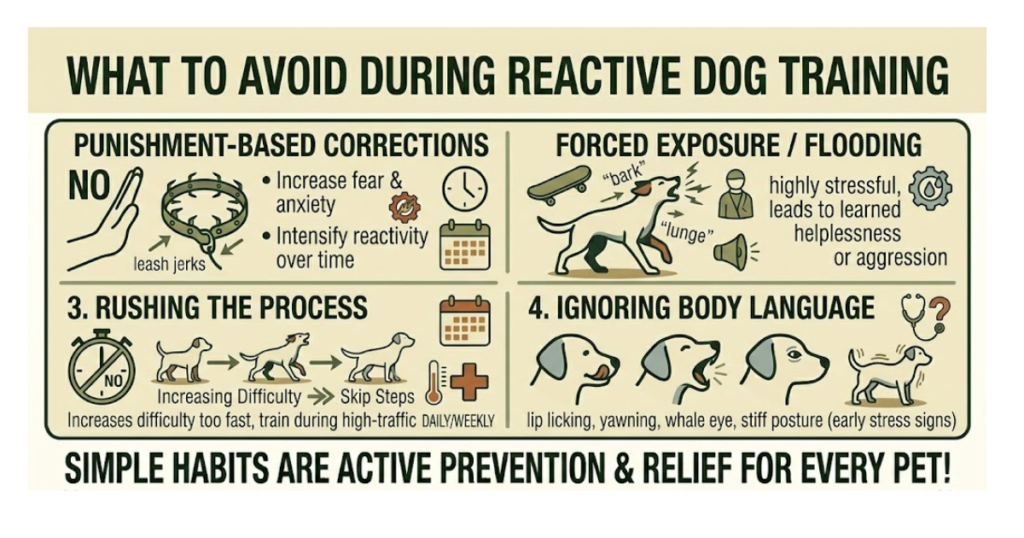
What to Avoid During Reactive Dog Training
Certain approaches can make reactivity worse rather than better. Specifically, avoid the following:
Punishment-based corrections — yelling, leash jerks, or prong/shock collars — increase fear and anxiety, which often intensifies reactivity over time.
Flooding, or forcing your dog to stay in a situation until it calms down, is highly stressful and can lead to learned helplessness or increased aggression.
Rushing the process by skipping steps, increasing difficulty too fast, or training during high-traffic times before your dog is ready.
Ignoring body language signals such as lip licking, yawning, whale eye, or stiff posture — these are early stress signs that your dog is approaching its threshold.
Patience and consistency matter more than speed. Taking one small step forward each week adds up to significant progress over months.
Managing Your Reactive Dog Day-to-Day
Training sessions are important, but day-to-day management is equally so. Here are practical habits that support progress:
Walk during quieter times of the day — early morning or late evening — to reduce the number of trigger encounters.
Use a front-clip harness or head halter, which gives you more physical control without causing pain.
Give your dog mental enrichment at home — sniff walks, puzzle feeders, and training games — to reduce overall stress and arousal.
Keep a training journal to note triggers, distance, and how your dog responded. Patterns often become visible over time.
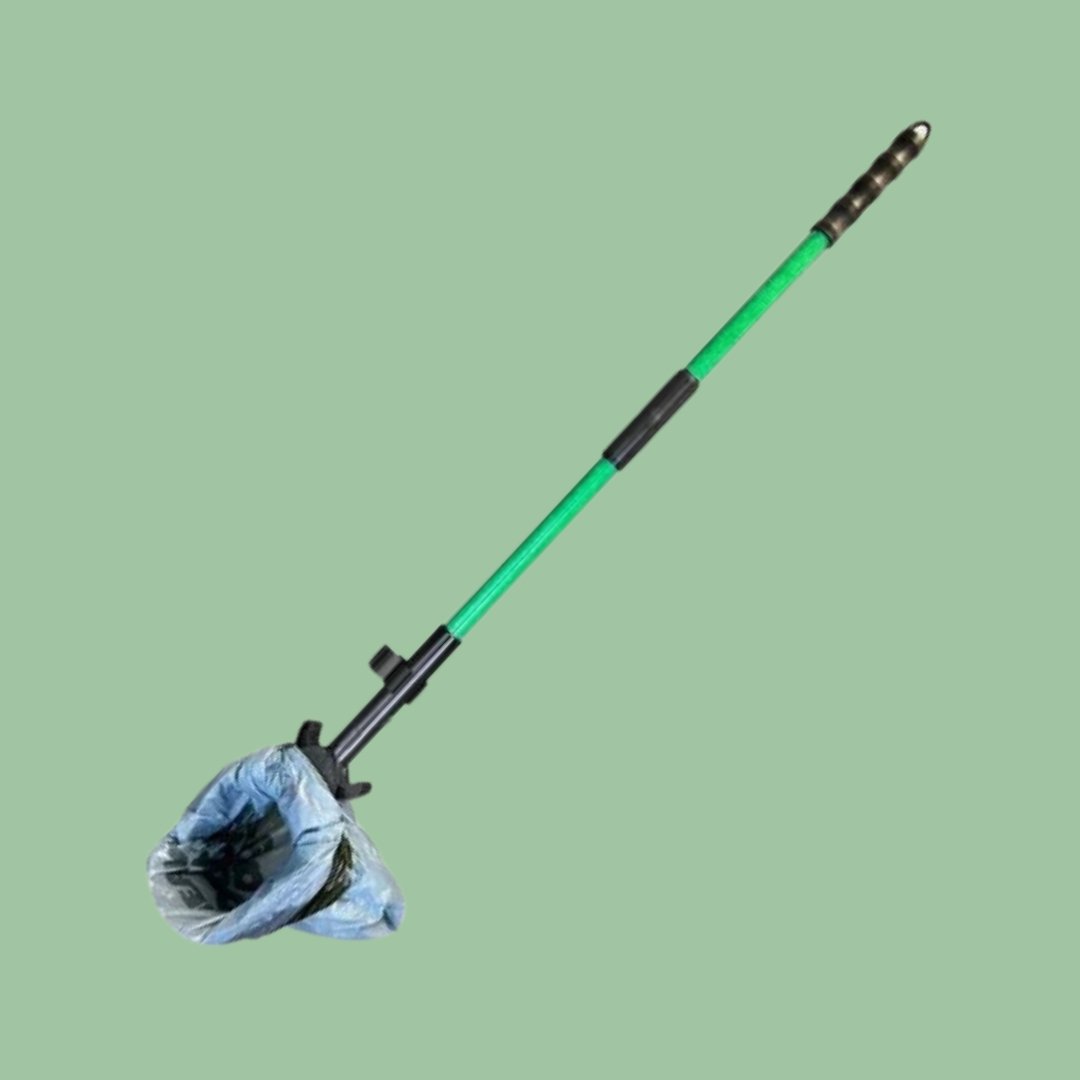
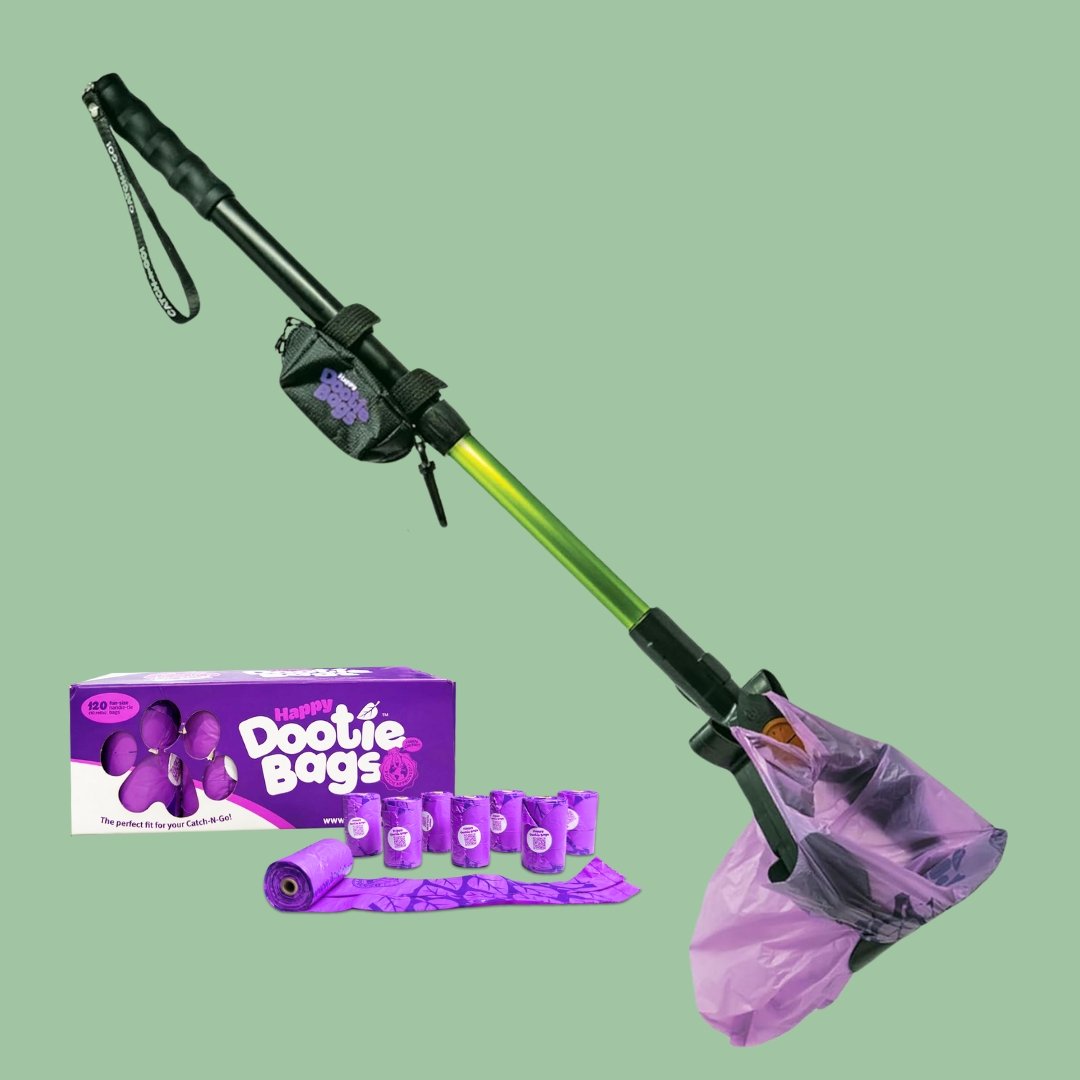
Part of responsible dog ownership also means keeping outdoor spaces clean and stress-free for everyone. Using quality dog poop bags and a pooper scooper from GOGO Stik makes cleanup quick and hygienic — so you can keep your focus on your dog during training walks.
How Long Does Reactive Dog Training Take?
There is no single answer here. Some dogs show improvement within weeks, while others need months or even years of consistent work. Factors that influence the timeline include:
How long the dog has been reactive
The intensity and variety of triggers
The dog’s age and overall health
The consistency and skill of the handler
Progress is rarely linear. You will likely see setbacks, especially during stressful life events or seasonal changes when outdoor activity increases. That said, even reactive dogs that have been struggling for years can make meaningful improvement with the right support.
Helpful Tools for Reactive Dog Owners
The right equipment does not train your dog, but it does make management easier and safer during the process. Some tools worth considering:
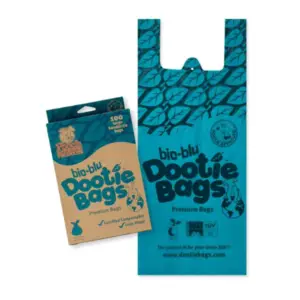
Bio Blu Dootie Bags — eco-friendly bags for environmentally conscious dog owners
Keeping these essentials on hand means you spend less mental energy on logistics and more on helping your dog succeed.
Final Thoughts
Reactive dog training is not a quick fix, but it is absolutely achievable. With patience, consistency, and the right techniques, you can help your dog feel less overwhelmed by the world around them.
Start where your dog is — not where you wish they were. Celebrate small wins. And on the tough days, remind yourself that every calm moment you build is laying the groundwork for a less reactive, more confident dog.GOGO Stik supports every part of your dog’s daily routine — from training walks to cleanup. Check out our full range of pooper scoopers, poop bags, and pet wipes to keep your walks clean, simple, and stress-free.
Trimming your dog’s nails is one of the most important parts of routine pet care. Yet, for many dog owners, it can feel stressful — both for you and your pup. The good news is that with the right tools, a calm approach, and a little practice, nail trimming becomes
Does your dog bark, lunge, or growl at other dogs, people, or moving objects? That reaction might feel frustrating, but it does not mean your dog is aggressive or untrainable. Reactive dogs simply respond to triggers with more intensity than the situation calls for. With the right approach, you can
If you keep finding dog hair on your couch, clothes, and floors, you are not alone. Dog shedding is one of the most common concerns among pet owners. While some shedding is completely normal, there are times when it signals something worth looking into. This guide walks you through the